
Openness instead of simplicity
On designing without dogma and the ambition to make every project a benchmark.
A conversation with Hadi Teherani about attitude, holism, and why the strongest designs often emerge where others merely demand “experience.”
For decades, Hadi Teherani has been one of the defining voices in German architecture and design. His buildings are widely recognizable and yet he consciously resists the ambition of enforcing a binding formal language. Instead, he describes design as discovery. Place, time, and task already contain the answer – one “only” has to recognize it.
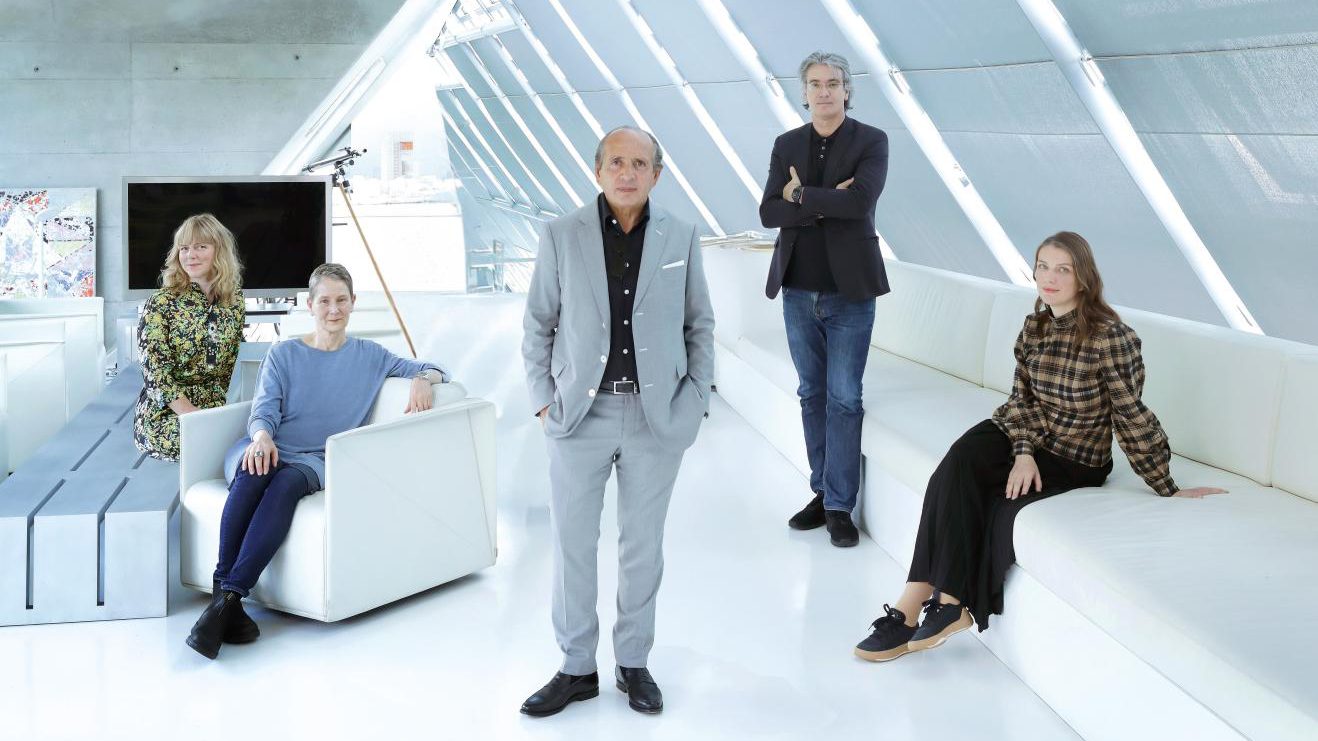
In this conversation, joined by Elke Malek, Head of Design at Hadi Teherani, we speak about early influences and entrepreneurial restlessness; about brand architecture without a brand manual; about the “plus” that turns function into identity; and about the thesis that regulation not only safeguards quality, but also prevents excellence.
"I always like to enjoy everything one hundred percent."
Could you describe a bit how you lived during your studies at TU Braunschweig?
HT: I quickly established an interesting shared apartment. I am rarely anonymous anywhere. When I arrive in a city, I try to understand its structures quickly. The first thing I did in Braunschweig was to look around: Who are the people here? What is the lifestyle?
And I quickly became friends with members of the aristocracy, around Braunschweig there were the Münchhausens, the von Feldheims, the von Hardenbergs, the Princess of Schleswig-Holstein. I was invited there; as a student, that was of course good: you get to sniff more of the whole picture. I had to finance my studies myself and quickly became visible in the city. I always like to enjoy everything one hundred percent. When I enter a city, I want to absorb something, the urban life, the people. I spent seven years in Braunschweig, and that time still resonates today.
You say seven years in Braunschweig. After that, you joined an office – how did things continue?
HT: I went straight to Cologne – my first job. It was a difficult time. I had told myself: I will apply to the very best first; if that doesn’t work, I will go one step down. I was lucky and was invited by Professor Schürmann.
At the time, we were planning the German Bundestag. And he probably found me interesting because I, as an Iranian with a Hamburg accent, spoke with him. That’s how I got the job. I worked for three and a half years at Schürmann’s office and then felt the urge to become self-employed. I rented an office and realized: you need money. I didn’t have any. So I taught two days a week at RWTH Aachen. Then I rented larger offices — and at the same time opened a fashion boutique for men’s clothing.
That was my first encounter with brand, because I needed my own brand — logo, name. It was called “Herrenhaus” — a house for architecture and for gentlemen: “Herrenhaus — Made by Architects.” I did fashion for three years … and through fashion I got my first architecture commission.
"Because it all happened so quickly, I had no time to think. I was under pressure 24 hours a day."
After your first commission, did you already have your own signature style? Or did that develop gradually?
HT: My first project had to be completed within a year: the car dealership “Car & Driver.” The client only wanted to sell cars with wings in the logo, Aston Martin, Bentley, everything with wings. So brand immediately became a topic again. I told myself: Now you have to design the building in a way that relates to cars. We mixed many details from automotive design with architecture.
Because everything happened so quickly, I had no time to think. I was under pressure 24 hours a day. Today, we could not manage that speed, it would require a huge team. Back then, I didn’t have one: students, no experience. On one hand, I didn’t know what I was doing. On the other, I had the ambition to execute everything in great detail and to a very high standard.
And then it was finished – and suddenly the press came. Suddenly everyone was interested, and I was standing on a stage I didn’t yet belong on. You stagger and think: Wow, why is everyone interested? I used that energy to continue on that path.
How long did it take – over the following projects – until you would say you had developed a personal signature?
HT: My signature was already there in the first project. I wouldn’t do it differently today. Everything I can design today was already developed back then.
Just like here in the office: the design language is now 29 years old – it’s practically a listed building. The path was set. Everything I learned, I learned from Schürmann: the toolbox of modernism. The eye – how things must meet, how minimal it must be. Sensitivity. Language. A concrete ceiling has energy. The floor. How do you express lightness, how heaviness? How do wall, floor, and ceiling speak to one another? How do you tell stories?
I absorbed that in a very short time. And that remains my approach to this day. That is why the first project was so good — despite the lack of experience.
It sounds as though you relied heavily on intuition.
HT: Yes. It is a mix of thinking and feeling what is right. You have to feel what is right. That was there from day one.
"I had no wealthy partners, I didn’t join an existing office. Everything grew from zero."
When you think about the term identity: what does identity mean to you, personally and professionally?
HT: I never read books about it or informed myself theoretically. Everything emerged from my own experience. And what I do is who I am. Even today, with large teams: you can see that what we do is one coherent whole, from lifestyle to how I want to work, how my surroundings should be. I had no wealthy partners, I didn’t join an office. Everything emerged from scratch.
HT: At most emotionally. There was no time to think. The speed was high. You only think: How do you achieve the next result? And that the result is so good again that nobody says: “The first one was just luck.”
My focus was always: top products. How do you deliver top performance, even without perfect conditions? You push everything in that direction, set benchmarks. I always set the goal very far ahead in order to reach it nonetheless. My first office in Hamburg: high-end. When you entered, you thought: “Successful for 10, 20 years.” But it was the first office. Because the ambition for the result was there. Whether I made or lost money did not matter. It was about achieving a result that would be noticed.
Today you work with very different clients. How do you approach understanding a client’s identity — through conversations, workshops, methods?
HT: We have a specific method whose roots are the same in architecture and product design. In architecture, I say: When I see a site, the design is already there – you just have to recognize, interpret, and implement the given parameters. I try to fulfill a task according to its conditions. I don’t squeeze a dream house onto a site. I derive the tailored suit from situation, time, place, society.
In product design it’s similar: When companies come to us, we first look into their DNA. How were they founded? What do they do? We don’t develop “in our sense,” but in the company’s sense. The product then becomes exactly what they currently need in order to move forward.
We look closely, analyze the task – and develop it further in its own spirit. Our teams are very good at this. I come in, and the boards are filled with mood images, with the company’s stories. Then we decide on the direction.
"If you keep your eyes open, you quickly sense what is right."
Despite the diversity of clients, one recognizes your buildings. Is there something like: “That’s a Teherani” – even if it was built for a brand?
HT: Yes, you can recognize that it’s from me — even though it’s for the brand. We unite both. The brand is not so strong that it must have nothing to do with us — our signature is part of it.
An example: DVAG. We designed a training center for them. The design had already been accepted and was about to be built. After the presentation, I drove home and told myself: No, we’ll do something else. Because I felt they were so focused on their own identity. So I took their logo — and developed the building out of the logo.
At first they were irritated: the design had already been approved. I said: You will now get your stamp. And what happened? We received ten or twelve additional commissions, because they could no longer build differently. Schools, centers — everything had to evolve from that principle. And with such a kind of magic trick, one commission suddenly becomes fourteen, spread across Germany.
You have to feel the brand, feel the people, feel what a company wants to express, where it wants to go. If you keep your eyes open, you quickly sense what is right.
There are architects who push their own formal language much more strongly. How do you view that?
HT: For me, that would be too restrictive. There are many famous architects. In Germany, there was Ungers — he always made squares, square windows. And at some point, that became dogma. People would have been surprised if he had suddenly done something else.
I keep the scale open. I don’t impose “my brand” because I want it that way. I develop from the site, from the context. Of course in my own handwriting. And in the end, that can still be read.
EM: And everything evolves anyway. Technology constantly brings new tools. Things that didn’t exist before. There was no 3D printer when we started. Suddenly new possibilities appear. You test them: What is our answer with these tools? The spectrum expands.
HT: But in design you need a feeling. That remains constant. If I build here in the harbor, where there was not even a designated building site — and the form becomes a landmark for Hamburg — then you feel the genius loci. You feel the answer. And that answer must not look like a normal office building.
This office building offers a public piazza on the roof that anyone can use, with a wide view. Suddenly an office building becomes an identity marker for the city. Whether it is this one or the Crane Houses in Cologne — they are photographed more often than the cathedral by now.
"I want the world to surprise me.That's an attitude."
Between the lines I hear usability, local reference, holism – and sometimes surprise. Are these the essential parameters guiding your thinking and actions?
HT: I am not an artist. I fulfill a task. If you are to create spaces for people, then you create the best spaces for people — under the most difficult conditions: urban planning, budget, etc.
You bring all of that together and create spaces as a service provider. If objects emerge from that which others say must have been created by an artist, then that is simply the result of intense work, not conceived as a sculpture “from the inside out.”
EM: We are not those “iconic” architects who represent a fixed formal language. With us, everything has a function. You can say: form follows function and also identity. But in the end, what counts is: Are the proportions right? Do you feel comfortable? Are materiality, scale, energy right for the people in that building?
This is based on a solid foundational education, something that is sometimes forgotten today because visualization is quick and the image looks “cool.” But having a place that truly functions, in scale to the human being, in the details, is something else.
With Zaha Hadid’s buildings, I initially felt that entering them was a new experience. Sometimes you could almost feel seasick because there wasn’t a single right angle. For a museum you don’t visit daily, that can be exciting. But a product, a place, must ultimately function in every detail.
HT: And we can do this because we understand design as craft. We think holistically: about yesterday and the day before yesterday; about the people who will work there; about budget; about sustainability. If you answer all questions, the product emerges.
As much as I appreciate such buildings: people would be surprised if I suddenly built a glass cube. They would ask: What happened?
But we can build buildings that flow like Zaha Hadid; we can build cubes like Mies van der Rohe – or something like Oscar Niemeyer. Because we have an open radar. And it was always important to me not to restrict myself too early. I want the world to surprise me. That is an attitude.
EM: When Hadi started working in design and there were no limits – when we asked ourselves what we embody and in which direction we specialize – we developed product brand family trees. We worked on that for a long time and ultimately realized: with this attitude, you can actually fulfill any task.
Many clients want specialists, or they want a clear signature – “everyone should see that Gehry built my house.” That exists. But that is not our approach.
HT: We take the work seriously. You don’t hide behind roles. When we receive a task, we take it seriously — no matter what it is: a birdhouse or a cufflink.
Quality is intensive work until it becomes good. And that we don’t give 100 percent, but 100 percent plus. We don’t just fulfill the task. Here, we didn’t just build “an office building”; we give something to the city, we give people a space, that plus makes the difference.
Do you see yourself more as a designer or as an architect?
HT: I am an architect. But for me, the boundaries to design are fluid. Buildings are also designed. One scale is larger, the other finer. But for us they are inseparable.
What makes a good briefing?
HT: A good briefing simplifies things. Many say: “I would be freer without a briefing, then I could dictate.” But without contact with tight parameters, it doesn’t work. And a briefing is not just a sheet of paper: it includes the spatial program, questions of urban planning, sustainability, society.
We started building office buildings early on. Back then, there were many individual offices with closed walls. In the 1990s we broke that open and gave people a different feeling of life at work. We always thought ahead. Not like a model student who simply fulfills an assignment. We fulfill it, but we also give a large bouquet of flowers on top, one that shines anew every day in its diversity and never wilts.
Are there situations in which you say: this is not a project for us?
HT: That practically doesn’t exist for us. It would have to be something very strange. Our task is to get the best out of a project. And there is no such thing as a “bad client”, no matter how difficult someone may be, we try to help them reach their own best outcome. In rare cases, someone is so stubborn that quality is reduced, but fundamentally, we bring clients to that level.
"If I want it, I do it. I work like an entrepreneur: I don't talk about it, I implement it."
Is there anything you haven't done yet – and would like to do?
HT: No, that doesn’t exist. If I want it, I do it. I function entrepreneurially: don’t talk about it, implement it. As soon as a thought appears, the idea of how to implement it comes simultaneously.
We are now working on renewable energy within the company. In product design, we do everything anyway. From textiles to cufflinks, flooring, suspended ceilings – even things that are supposedly “uninteresting.” We face the task. And strangely enough, even in the most banal task, there is always a window that brings the task to life.
EM: As a designer, I can say: because of the references from architecture, a special level emerges. You can think more freely about products and suddenly give them a new image. And companies use that: Hadi can embody it. You might have done it with another designer, but he wouldn’t be able to embody it. And then people wouldn’t believe it.
I applied to Hadi because around 2000 he developed this mobile folding workstation. “New Work” was already a topic then, but classic design offices were only allowed to design within systems. Inventing a new category out of the box was easier with an architectural background. Standing and references help: Berliner Bogen, Crane Houses, that engineering logic is believable. That enables transfer, and companies like Interstuhl were able to grow as a brand through it.
HT: We had “green” buildings before anyone wrote about them, timber constructions, greenery within buildings. Many things that are demanded today, we had earlier. And that was possible because in architecture there were references, examples, know-how, and because one could transfer them.
EM: It enables different paths. And Interstuhl was a company that wasn’t known among architects, yet with our chair, they conquered an entirely new segment. Suddenly they toured across Europe, created events everywhere, invited Hadi, organized lectures – and achieved a completely different transfer. They became more known as a brand. That’s a major ambition.
I personally find that extremely fascinating: how through architecture you didn’t ask for permission, but carved out the field for yourselves and then transferred it into all other areas and consistently implemented it in design, in a comprehensive way.
HT: If you have such strong role models as the Bauhaus: if those guys could do it back then, why shouldn’t I be able to do it now? We have all designed beautiful furniture that are classics today. There are more classics by architects than by “pure” designers.
Classical product design is also a younger discipline than architecture. Gropius, van der Rohe, Le Corbusier, they all created things that people still want today.
Do you have many clients who allow you to work holistically – architecture, interior, up to the story?
HT: Rather not. In architecture, they come and want a building, and now, because it has become fashionable, architecture is often only granted 30 or 40 percent of the budget it would actually require. Competitors then make it to the building permit stage, and inevitably the details suffer.
That you could deliver much more – so that it becomes a total object – you mostly find with people who build for themselves. Those who build for the market are not interested.
But someone building a corporate headquarters for themselves: yes. They go along with it. And there are one or two residential projects that have a “Hadi Teherani specification.” That exists as well. They like to advertise with it, because they suddenly realize: maybe we can tell customers a story, about the architect. Then, of course, they like to use me as a meaning-maker.
I saw that you designed, I believe, a summer house not too long ago. The thatched-roof house, correct? Was that an opportunity for you to carry something through holistically?
HT: No. It was simply a house in a settlement of thatched-roof houses, so it was clear: it also needed a thatched roof. But we had to find a language, not traditional like all the others. Without overwhelming anyone. And meanwhile everyone drives there to look at it.
"For new concepts, you need freedom of thought - other countries often offer more opportunities."
Has that changed over the past 10–15 years, from private houses to larger clients? You mentioned earlier that services are sometimes awarded more narrowly. Has that changed? Or has it stayed the same, and people just complain more?
HT: For us, the office grows and shrinks, grows and shrinks. But the way we live with architecture, what we do, has remained the same.
The market always changes. In difficult times, people look for ideas to stand out. In good times, architecture matters less, everything that exists is sold and rented. In tighter times, you ask yourself: what can I do so that the three tenants who exist come to me? That happens through architecture – by offering better architecture.
At the same time, the level has developed: there are not so many truly bad architects anymore. Much is average, and everything aligns with that. But real peaks have become rarer here, you find them more in countries where more space is allowed.
Here, the space is missing. Everything is already predetermined. Development plans define height, width, building lines. Perhaps you can vary the façade slightly, but the framework becomes narrower and narrower. For new concepts, you need freedom in thinking – other countries often offer more room for that.
What is the most exciting place in the world for you to follow architecture?
HT: It’s exciting everywhere. More happens where there is the financial capacity to afford things. Here, every centimeter is calculated precisely, not too much, not too little. But experimentation doesn’t happen here.
And that also has to do with regulation. In Germany, for a long time, people said mixed-use doesn’t work: living, working, hotel. Abroad, that’s everyday life. Here, all problems are thought through beforehand – elevators, strollers, subdivision – instead of simply doing it and learning.
Cities define the framework, sometimes so tightly that possible peaks fail in advance. The ordinary is very good here, but the extraordinary emerges with more difficulty.
"We like to build things that are pillars of identity."
When you think about yourself – as architect, designer, entrepreneur – what would you like to leave behind?
HT: I only want things that function, that function for as long as possible, and that function sustainably. Others decide whether that is the right legacy.
This building here has received heritage protection. Others recognized that and said: this is cultural heritage. We like to build things that are pillars of identity.
And I give buildings nicknames while we work on them, and often that name later becomes the hit. Crane Houses. Dancing Towers. Dockland. In Hamburg, there is even a bus stop called Dockland, and that was our working title. That’s how you create brand, identity.
Of course, one could also market all of this “classically” – brochures, communication design, films, photos. With the chair, that began: that we didn’t only design the product, but also the language of images. Not a classical office-furniture set created by some agency, I prefer to immerse myself in it. It’s very intuitive.
HT: We deal with this every day, and we can get things to the point. I can immediately give a copywriter slogans, compress a brand identity into two words, at the push of a button. But few allow themselves that freedom.
EM: When you say, “The design is already there, you just have to recognize it,” it sounds easy, but behind it is a solid performance. And of course, an agency doesn’t live from you saying in two minutes, “There’s the slogan”, it requires processes and experience.
But especially today, in times of AI, the human impulse counts – gut feeling, emotion, sense of scale. Not only rationality, data, and analysis. That makes the whole thing unique and not copyable. No one can come along and say: we’ll just do it the same way.
Just as little as we can say: we offer this product to another company. It was designed only for the original company, and if they no longer produce it, we can’t go elsewhere and say, “You make it.” It is bound to the brand.
HT: We feel capable of developing color scales ourselves, of setting design trends, of arranging things as they need to be. And that only comes from bringing together knowledge of the past and knowledge of the future.
If you are a holistic person, who sees everything, society, history, etc., then the right thing emerges automatically. Without a grand philosophy. We don’t have one.
EM: But there is a clear attitude. Not theoretical, more as personality. We also always work in buildings that come from this office and from Hadi Teherani, to feel every day where we stand and what we belong to. It’s the same with clients.
"Attitude is the magic word."
HT: Attitude is the magic word. Buildings with attitude have quality. The arbitrary can be replaced. And it’s the same with people: those who have a certain attitude impress you more than those who simply drift along.
You can’t put that into a formula. There are brand manuals and frameworks – of course. But that something, that impulse, that gut feeling, you can’t put it into words. And that’s why it isn’t copyable.
About 1,600 people have worked with me, perhaps 1,700 by now. Many have become self-employed. And I have found hardly any alignment in attitude.
EM: That moment of surprise that keeps returning. And this openness: not saying, “I’ve figured it out, squares are the recipe,” but asking: where is the journey heading? Where is the future heading?
Now there is AI, now there are renewable energies, and in our office there is no “not interested.” Instead: whatever comes is examined. Even though we are an established office. That surprises people again and again. And it is exhausting. It is wonderful, but truly exhausting. No boredom, but no autopilot either.
HT: It’s the same for employees. They’re surprised — suddenly new names appear on the doorbell. “What’s that?” – “That’s my development company, the solar company.” Employees must always expect surprises.
"For something special, you need an incalculable recipe."
My impression is: your connecting element operates on another level. Not codified like in a brand manual, but more subtle. There are recurring patterns, I find that fascinating. And the beautiful thing is: you are here, in this building, and you constantly convey a feeling to your employees. I sense it in the conversation, and I sense it when I enter downstairs. I find that incredibly fascinating.
HT: And if you create such a platform where these things can happen … for me, it was important from the beginning to prepare myself for what might come next, even though I don’t know what that is.
That I mentally prepare: if suddenly many commissions come, I don’t want to say “I can’t manage that.” Or if tasks come from completely different fields. I try to shape the foundation so that I am prepared for the next thing, which I don’t even know yet.
EM: And rarely does a task come twice, economically, that may sometimes be complete madness. But I believe this humanistic aspect is good. It suits us more. That may also be what makes the difference again today.
HT: Many ask: “Have you ever done a bank?” But everything is the first time at some point. Our first bank was a sensation. Our first spa won 16 awards. Still, many believe experience is the recipe.
EM: For something special, you need an incalculable recipe.
HT: It’s hard to convey, that we are, in a way, specialized in everything. No hospital builder comes to us and says, “Design us a hospital.” But I know: if we rethought the task of a hospital, it would be the best hospital.
Too many regulations make you operationally blind. Freedom is lost. You no longer start from the human being.
My first project – the car dealership: Rolls-Royce came and said, “This would be the most beautiful dealership worldwide.” And you think: that was my first task. That was 1990. Back then, cars were sold in some shed, with a few lamps on the ceiling.
With us, everything was already there: glass tilted so that no reflections disturbed. The logos of the cars integrated into the structure. Wings everywhere. The lightness of automotive engineering. Aluminum and glass in one plane. That didn’t exist back then. Those glass fixings were the first point-fixed glass panes in Germany. All of it, without the slightest prior knowledge.
My first project. I could tell stories about it for two hours – even though it was 35 years ago.
"From my experience, feeling is the most important thing."
One can clearly sense: no abstract philosophy — but an attitude, an approach. That is important. Is there anything else you would like to share?
HT: There are companies that have a brand identity. In architecture, BMW, for example, with the cylinder building. That developed from something. Many companies don’t have that. We try to give companies we build for something like that: a corporate architecture.
About 25 years ago, I gave an interview – I believe for Spiegel or Handelsblatt – where DAX companies were analyzed regarding which had a brand architecture. Perhaps the article can still be found.
People who have studied brand know these things much better. I have never read a brand manual. I do it from feeling. You can learn, you can inform yourself, but from my experience, feeling is the most important thing.
That is exactly what I found so fascinating in our conversation: it’s less about methods or tools, and more about the feeling behind it. About the connecting elements – attitude, attentiveness, consequence.
HT: Exactly. Perhaps that is characteristic: good work does not arise from protocols or rules, but from attitude. From a sense of what is right. And from the willingness to take responsibility, for the result, for the place, for the people.
Thank you very much for this inspiring conversation and for your time.
Leave a Reply