
Making the Case for Marketing: How Budget Decisions Are Really Won
“… sounds good but we don’t have enough marketing budget at my company.”
How many times have you heard this point before? Have you been through it yourself?
This is one of the most common complaints I’ve heard from marketing professionals during my career. I’ve heard it from CMOs during my time as a brand consultant, from colleagues leading marketing for startups, from agency friends working with brands that wouldn’t advance the work for lack of funding, from classmates during my marketing training and from teachers and thought leaders. Even at the LEGO Group, which does put considerable attention and cash toward marketing and brand, I hear it from colleagues leading projects they believe should be better funded.
71% of CMOs say they lack the budget to execute their strategy… [1].
So, what is going on here?
THE PROBLEM
At its core, I think we are just not very good at asking for money. Which is ironic, as marketing is likely one of the business functions that is mostly asking for it.
And the problem is that it is important. Very important.
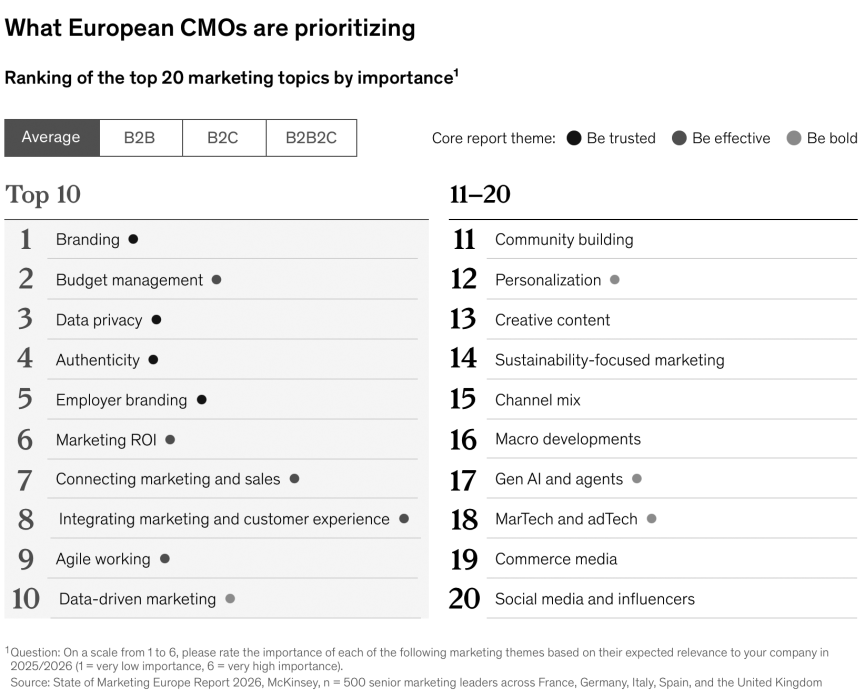
Budget management is not only the #2 priority for CMOs…
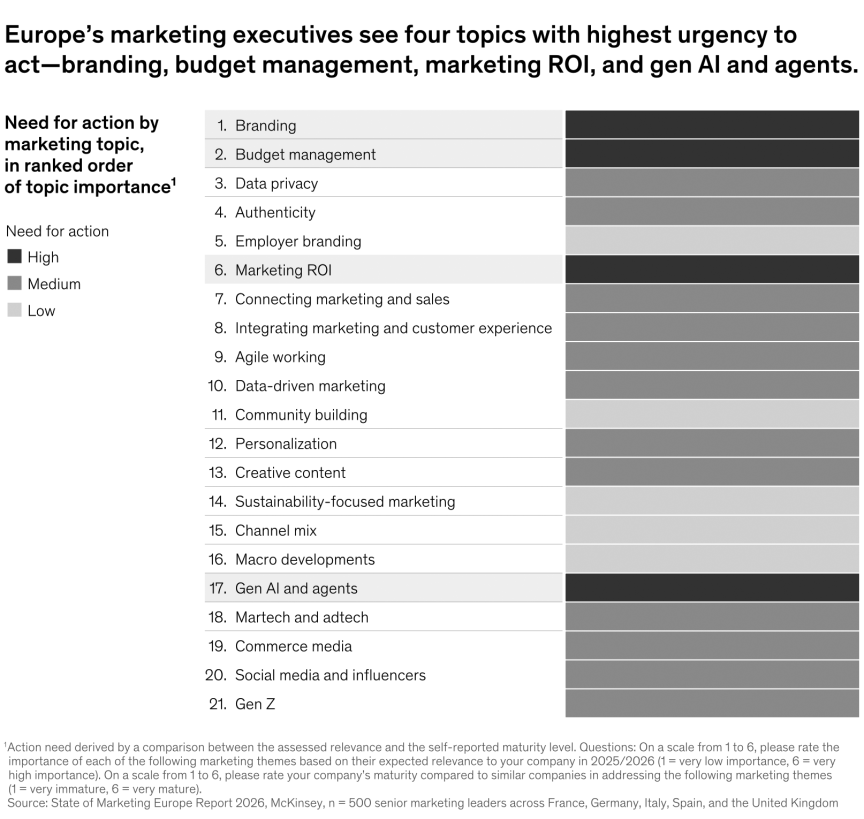
… it is also rated as having a high urgency to act [2].
Especially the part of the budget destined to brand communications and activation, which is usually the most challenging area to make the case for given that the proof of returns is less direct than, say, an investment in digital activation, quick response communications.
Without money, we are left to sheer luck, hoping our content goes “viral.” Marketers like to think that ROI is very important, but data shows that the size of your budget is eight times more important [3]. It’s simple math: if you invest $100 in a campaign and get an exceptional 10x ROI, you made $1,000; if you invested $1,000 and got only a 2x ROI, you made $2,000. Twice as much money for an ROI five times smaller.
In short: knowing how to get marketing money is very important, we are always doing it and, still, we suck at it.
WHY MARKETERS CAN’T GET MONEY
I think there are a few reasons hindering marketers from getting money to fund their plans. And it starts with…
- MINDSET AND LANGUAGE. Often we think that the marketing job is about creating cool content that will look good on social media. That’s not it. The job is to bring new customers to the business who are willing to pay more and hopefully come back in the future. That translates into revenue growth, higher margins, and lower business risk. This mindset shows up in the language we use. Speaking about “building a strong brand,” “brand love,” “creating a movement,” or marketing metrics that no one understands creates confusion and mistrust.
- NO EDUCATION. That’s when the marketing leader has a good idea about the discipline, but the broader business thinks of it as a nice-to-have function. There is no clarity about how it helps the business, especially around the importance of building brand equity. Or even worse — people think of it as a team that spends a lot and brings little in return. That lack of understanding is common in companies of all sizes, especially those that are heavily sales or product-oriented.
- BUSINESS DISCONNECT. That’s when the ideas and plans proposed by the marketing team have a weak or no link to what the business is trying to achieve. For example, when the business is trying to grow in a new category and the marketer presents a cool idea on how to make fun of the competition in its core business. It may feel good when presented on a stage at Cannes, but the metrics it says it delivers won’t move the business where it needs to be.
- BAD OR NO DATA. Poor data makes for a poor case for investments. We often see asks based on a single observation from competitors, personal experience, or a new trend report that is so general it doesn’t mean anything. Nothing wrong with that, and qualitative data is an important part of any diagnostic, but in a sea of competing priorities, hard quantitative data is the compass to guide business decisions. Sometimes those are included, but are “bad data”: views, clicks, and likes that lead to the wrong conclusions.
- BAD COORDINATION. Maybe you are a marketing wizard, know everything about the fundamentals, studied the brand, crafted a smart strategy, brought in the data… but forgot to align ahead of time with the people making the call or influencing the decision on budget allocation. There’s no sadder way to bin a great case for brand than getting it smashed by an audience that was caught by surprise and forced into a rushed decision.
It’s not easy. There’s a lot expected from marketers, ranging across a diverse set of skills — from bringing creative ideas to crafting robust financial cases. But that also means that mastering budgeting is an opportunity that will set you apart from peers and move you faster in a career in the industry. Even better, there are known ways to do it well.
HOW TO GET GOOD AT ASKING FOR MONEY
This is not a complete manual, but I do want to leave you with an initial overview in five steps of how to think and what to do when asking for budget.
1. Speak the language of business, not marketing
First, get into the right mindset and prove it by changing how you speak. Your number one job is to bring new customers and represent the outside world inside your company, not to create beautiful ads. Marketing is a business function that operates under constraints of market dynamics and company capabilities — it’s not the art department.
With that in mind, get rid of marketing jargon and use language that the average businessperson will understand. Talk about market share, contribution margin, new customer acquisition, and leave the nerdy marketing metrics to the marketing team. If you go to the CEO or CFO sounding like “we need more budget to build the brand,” you will lose. Go sounding like “here’s the growth we are leaving on the table and the risks of not doing anything about it.”
2. Build understanding before you ask for budget
Second, educate the organization on the fundamentals. There is a science to marketing, like architecture — it requires craft and creativity, but without getting the scientific laws right, the house won’t stay up. Start with general rules like the 95/5 (only 5% of customers are in the market at a given time), the 80% rule (the share of consumers who buy a brand they already knew before entering the market), pricing power, correlation of brand value and share performance, or even some Les Binet’s 60/40. Then get specific about your industry and bring case studies from competitors (good and bad ones) and complement them with examples from your own company when marketing helped the business succeed.
3. Anchor marketing in business strategy
Third, design a marketing strategy connected with business goals. This is your time to shine — show confidence in your marketing skills and a vision for how to grow the business. Make sure that brand building principles are part of that strategy, so that it is not only focused on the short term. Spend enough time on a proper diagnostic, then choose your target, define your positioning, and list your objectives. Finally, and only at the end of this stage, select the best tactics to deliver on your strategy. Be bold, creative, and diligent with the strategy process.
4. Quantify the impact and model the options
Fourth, do the math. Often the budget is given to the marketing team by finance based on a percentage ratio of the next year’s revenue forecast. Research shows that 5% to 10% of forecasted revenue for marketing is a fair rule of thumb and offers a place to start. But you can take more control and influence this ballpark based on what you think marketing can achieve.
Use simple logic such as:
Spend Required > Tactics > Target, Positioning and Objectives (linking to brand funnel) > Business Outcomes
Once your team matures, there are different tools you can use to bridge marketing metrics to business outcomes such as Excess Share of Voice (eSOV), to more comprehensive ones such as marketing mix modelling. None are perfect, and it is worth using more than one to cross-reference results.
Don’t forget to bring different scenarios with different growth, spend, and risk profiles. Have a point of view on which one you think is best but use the options as a discussion point with the leadership.
5. Align stakeholders before the decision is made
Fifth, the part that many times is overlooked. Even if you crafted a brilliant strategy and business case, you risk not getting it approved if the decision-makers are not well informed and aligned. Do the groundwork and share your plan with the CFO, the CEO, and whoever can influence the decision ahead of time. Even better: ask the CFO to co-present the plan with you. Then listen to as much feedback as possible and adjust your plan accordingly. What you want is to have a presentation that is mostly pro forma; the real plan has already been approved behind the scenes.
The steps above may change depending on your company’s culture or the context in which you are asking for money. For example, if you work for a business that already has a high level of marketing education and understanding, you may want to skip to the strategy part. Or if you need money quickly to respond to something happening in culture rather than the more robust annual planning process, you may skip a bigger strategic exercise and just look for data to support your idea and link it to business goals.
CONCLUSION
The more I think about how best marketing can get money, the more I’m convinced it is one of the most important questions a marketing leader can ask herself.
If you can convince your CEO and CFO to approve the budget you need, it is likely that you speak the language of the board, you have a compelling vision and can design a strategy connected with business goals. You are not afraid of data and you can successfully navigate corporate politics.
It’s also likely that you will advance faster in a career in marketing compared to your peers.
Confidence, logic, creativity, and math are powerful things. They should also be applied to budgeting. It’s not easy or fast, but you will have to do it anyway.Why not try and do your best, then?
_
Sources
[1] Gartner’s 2023 CMO Spend and Strategy Survey
[2] McKinsey – State of Marketing Europe Report 2026, n = 500 marketing leaders
[3] Medialab CMO Survey 2025 and Les Binet analysis, IPA Databank 1998-2025

Leave a Reply