Raymond Loewy, the spirit of the times and the M.A.Y.A. principle: how much 'modernity' can a brand tolerate?
In both design and communication, the question of innovation arises time and again. How much innovation is necessary or acceptable or unacceptable to convey a brand, product or important message to a specific target audience? In attempting to answer this question, I was reminded of the French American design pioneer Raymond Loewy (1893–1983) and his M.A.Y.A. principle (Most Advanced Yet Acceptable). This, in turn, reminded me of a light blue-turquoise Studebaker Commander Starlight Coupé from the 1950s. My elementary school teacher, Mr. Zimmermann's wife drove a model like this. But they also owned a second car, a Citroën Deux Chevaux, which was the exact antithesis of the Studebaker. [1]

These two products remind me of 1950s design and the difference between the European and American approaches to design, which we somewhat disparagingly referred to as “styling.” Designers such as Raymond Loewy, Walter Teague, Henry Dreyfuss and Norman Bel Geddes represented a style that captured the essence of the American dream, finding expression in film and music entertainment. Of course, there were other design concepts in the US at the time, such as the work of Ray and Charles Eames, Ero Saarinnen, and George Nelson, who represented a more European approach to design.
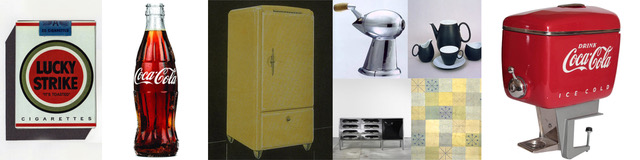
But let's stick with the former, which represented a more commercial style that, in retrospect, exudes a very specific charm — especially compared to the rather austere European design. Examples of Raymond Loewy's famous works include the Studebaker, the Greyhound bus, the Coca-Cola bottle and the dispenser and the Coldspot refrigerator. These designs fit brilliantly with the era of Marilyn Monroe, James Dean, Audrey Hepburn, Charlie Parker, Miles Davis, Elvis Presley and Frank Sinatra. [2]
From a European perspective, designers such as Giò Ponti, Arne Jacobsen, Hans Gugelot, Dieter Rams or Marco Zanuso spring to mind. Products from Braun (such as radios and razors), the Superleggera chair from Cassina, the Cylinda line from Stelton, Olivetti typewriters, the Citroën CV2 or the Fiat 500 and 600 spring to mind. These products were created in the 1950s when Sophia Loren, Brigitte Bardot, Ingrid Bergman, Alec Guinness and Marcello Mastroianni were admired, and the music of Edith Piaf, Charles Aznavour, Vico Torriani, Mina, Caterina Valente and Peter Kraus were listened to. [3]

This comparison has been deliberately exaggerated to highlight two fundamental attitudes that still influence marketing and design today. The question of the zeitgeist, and in particular the relationship between design and everyday culture, is highly relevant. What was clear from a European perspective at the time is somewhat relativized in retrospect. Perhaps the American view was “sexier”, but also very fleeting, while the European view was more Protestant and had a much longer-lasting effect.
This is precisely where Loewy's famous M.A.Y.A. principle (Most Advanced Yet Acceptable) comes into play. It succinctly encapsulates the American, market-oriented mindset. How far can innovation go without losing the audience? In contrast, the European approach, shaped by Peter Behrens, the Werkbund and later Ulm, asks: How do we solve the problem correctly? Both questions are valid, but they lead to different outcomes: exciting styling on the one hand, and reliable durability on the other. However, M.A.Y.A. is more than just a historical footnote. It is a fundamental formula for the acceptance of any innovation. Even today, it defines the tension in every rebranding exercise, every new product and every campaign: the balance between novelty and familiarity.
Whether and to what extent we can or want to embrace zeitgeist remains an interesting question. This is where the M.A.Y.A. principle becomes relevant again. According to communication theory, a certain amount of innovation is required to attract the attention of target groups — what is already known does not generate attraction — but the degree of novelty and surprise must not be excessive, otherwise the message or artefact will be incomprehensible. In the context of current branding discussions and design and communication in general, the M.A.Y.A. question is more pressing than ever: how can brands and products remain contemporary and relevant without sacrificing their core values and recognizability? Today, this could mean adopting a progressive attitude, introducing a new visual detail or collaborating with others. The 'acceptable' element ensures loyalty to the existing community.
This concept is logical and still valid. However, the question of zeitgeist seems to me to be much more complex and difficult to answer. While it is correct to follow certain trends, it is difficult to determine where the line between pandering and differentiation lies. Personally, I find the fact that I make a much clearer assessment when I think about the past interesting and stimulating. Perhaps the real art of branding today is not about capturing the zeitgeist, but finding your own authentic, adaptable expression that applies the M.A.Y.A. principle to values as well as aesthetics. How much zeitgeist can a brand or product tolerate? How can I keep a brand or product contemporary without sacrificing core values and recognition? This question is more pressing today than ever before, particularly when engaging with target groups such as Generation Z, for whom authenticity and consistent values are non-negotiable. This is where M.A.Y.A. becomes a formula for survival: how much 'zeitgeist' can a brand tolerate before it loses credibility? [4]
[1] Studebaker Commander Starlight Coupe 1953 and Citroën 2 CV 1948
[2] Lucky Strike 1940, Coca Cola 1955, Coldspot refrigerator (for Sears) 1953 and various works by Raymond Loevy from the 1950s
[3] Braun radio and record player 1958, and shaver 1962, Superleggera ca. 1950, Fiat 600 Multiplo 1956 and Jacobsen Chair 1952
[4] The AI model DeepSeek (version DeepSeek-V3, as of July 2024) was used for research and text optimization.