
Walkers Welcome
What has a stock price got to do with brand? Everything.
Bill Bowerman built Nike on one idea: if you have a body, you're an athlete. A declaration. It shaped the product, the advertising, the athletes they backed, and the people they hired.
For decades, it held.
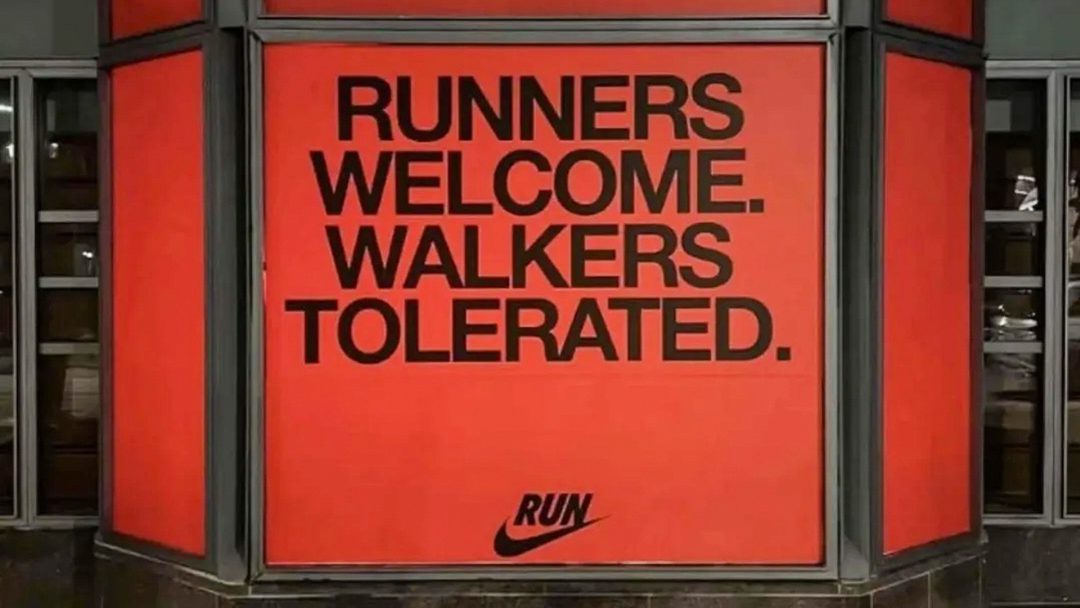
In April this year, as many know and have commented on, Nike ran an ad at the Boston Marathon disparaging walkers. TikTok and LinkedIn took over. Critics said the brand was softening, drifting from competition into something more palatable.
Chances are, those critics have never been to the 26.2-mile mark. And neither had the marketing team. (This article is not about walking or running. It’s about misses.)
You have to qualify to run Boston via other marathons. The course is hilly and unforgiving. Many runners who get there make Boston an A race, training specifically for a finish time. In any endurance sport, there's a razor-thin line between pushing your limits and blowing up. It’s about managing that line before glycogen depletes, and the body stops responding. On average, 30 to 40 percent of marathoners hit the wall around mile 20.
The medal at Boston is more precious than those in other marathons. So the athletes who hit the wall keep going. At this point, finishing is more important than the finish time. They walk or jog those final miles. Refusing to quit. Just, well, doing it!
That is the whole story. Bowerman's story. The one Nike was built on.
The team that approved the ad missed the point entirely. And it wasn't one rogue decision. It was the result of years of accumulated drift. Many layers of smaller decisions and gaps between the brand and its Foundation.
Brand drift is almost never a single bad call. It's the accumulation of many seemingly easy calls.
You shift the budget toward lifestyle because that's where the faster-fashion sits. You sign celebrities because they move product faster. You lean into retro franchises because they boost short-term sales. You pull back from wholesale and go direct-to-consumer because the data shows stronger margins. Individually, each decision looks comfortable and defensible. Collectively, they move you away from the thing that made you matter in the first place.
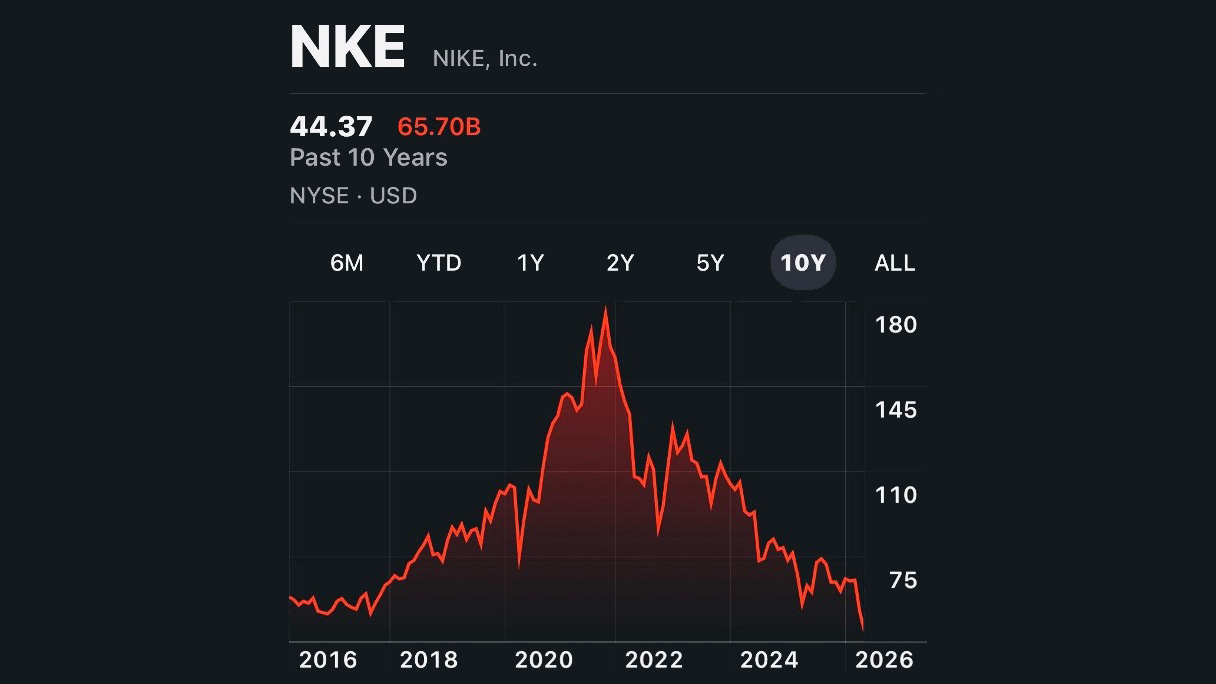
Nike's stock hit an all-time high of roughly $179 in November 2021. Four consecutive years of decline followed, down 30% in 2022, down again in 2023, down 30% again in 2024, and further into 2025. A market cap that once sat at $281 billion fell below $100 billion. The valuation premium Nike once commanded nearly vanished.
The CEO at the helm throughout that entire decline was John Donahoe, a former Bain consultant, former eBay CEO, and former ServiceNow CEO. He was brought in to modernize Nike into a digital platform company. Platform thinking. DTC and e-commerce push. Data and systems mindset.
Tools are just a layer on top of the brand
Donahoe was a competent operator. He just wasn't a Nike person. He hadn't grown up inside the company. Couldn't feel the difference between the brand and what would bring it to life (the tools). Donahoe pushed DTC because the margins looked easy. He made the comfortable decision to pull back from wholesale because the data said to. He ran the company like a system. But Nike isn’t a system, it’s an ethos.
Compare that to Mark Parker, who ran Nike from 2006 to 2020. Parker was a footwear designer. He came up through product and branding. In 2018, the "Dream Crazy" campaign launched, featuring Colin Kaepernick. The internet erupted. Online sales surged 31 percent in the days that followed, according to Edison Trends. The stock kept climbing, hitting its all-time peak by November 2021, still riding the foundation Parker had protected.
The campaign landed because the foundation was visible. You could feel who Nike was talking to before the swoosh appeared.
Then Parker left. Donahoe arrived. And Nike spent four years efficiently dismantling what had taken decades to build.
Today
Elliott Hill returned to Beaverton in late 2024 after four years away. He started his 32-year career at Nike as a sales intern. He bled the PNW. On his first earnings call, he said it plainly: "We lost our obsession with sport. Moving forward, we will lead with sport and put the athlete at the center of every decision."
Lead with sport and the athlete, and put tech and tools on top!
He named the drift on day one. He could name it because he'd been shaped by the Foundation for three decades. You don't need a consultant to tell you what Nike is supposed to be. You just know.
Boards look for a silver bullet from outside when the answers were inside all along. The Starbucks CEO who struggled in recent years wasn't from a business built on creating a local welcome (he came from consulting).
Bjørn Gulden at Adidas is the counter-example. He walked in at the start of 2023, facing the company's first net loss since 1992. He made the uncomfortable decision to strip the company back immediately. Importantly, Gulden cut the celebrity deals, returned to the Samba and the Gazelle, and refocused on athletes and performance. Since the start of 2023, Adidas stock has climbed 74 percent.
Gulden stopped burying the Foundation.
Nike's Foundation is still there. The walkers at Boston are athletes. Anyone who dragged themselves to mile 20 and kept going is exactly who Bowerman was talking about. Exactly who "Just Do It" was always for.
Elliott Hill knows it. The stock market knows it. The only question is whether the work of getting back takes less time than the drift away did.

Leave a Reply